Insights
5 ways tech is transforming retail to meet today’s challenges


4 minutes
7th May 2026
Share this article:
The retail industry never stops evolving.
Economic pressure, customer expectations and longer-term demographic
shifts continue to create challenges for retailers to navigate in 2026.
At the same time, technology is no longer just an enabler in the background.
AI is becoming critical business infrastructure. Online and offline channels are converging into a single, unified commerce model. And connected stores are increasingly operating as real-time data engines, continuously sensing, learning and responding.
This shift demands a network that is not only fast and resilient but also secured by a modern, cloud-delivered architecture like secure access service edge (SASE), combining zero-trust principles with data-centric protection across every channel.
All this is prompting retailers to ask:
- Is our network ready for always-on AI across pricing, personalisation and store operations?
- Can our stores act as both media channels and fulfilment centres while maintaining secure, compliant data flows?
- Do we have a unified connectivity and zero-trust security foundation for colleagues, devices and application programming interfaces (APIs)?
Let’s take a look at five ways tech can support retailers in tackling today’s challenges and planning for the future.
1. Coping with supply chain volatility through better visibility
Ongoing geopolitical tensions, climate disruption and energy price volatility continue to impact supply chains in 2026. Retailers must also meet rising sustainability and Digital Product Passport requirements.
Uncertainty over availability, long lead times and rising costs are squeezing margins and testing customer trust.
One thing that can help is greater visibility and control, with supply chains treated as connected, data-rich networks rather than linear processes.
A combination of sensor-based tracking, centralised asset monitoring and AI- driven forecasting can provide near real-time insight into where stock is, how it’s moving and where risk is building. This is supported by software-defined wide area networks and SASE security that protects the sensitive supply chain data and API flows.
This also supports compliance with the Product Security and Telecommunications Infrastructure Act for internet of things (IoT) devices.
The result is more accurate information for customers, better planning for teams and stronger confidence in availability across both digital and physical channels.
2. Reducing supply chain costs through smarter solutions
Technology can also help reduce costs, particularly when AI and connectivity work together across logistics and fulfilment.
Examples include:
- Route optimisation for vehicles to cut fuel use and maintenance
- Using stores as fulfilment points to reduce third-party warehousing
- Remote monitoring of storage conditions to limit waste, for example chilled goods
Automation in distribution centres, including robotics supported by low- latency connectivity, is also becoming more common.
Many of these capabilities rely on resilient fixed and mobile networks, private 5G and WiFi and consistent security across sites, enabling data to flow safely between vehicles, warehouses, stores and cloud platforms.
Could your current connectivity cope with all this?
3. Optimising store formats and layout to enhance customer experiences
Every retailer knows the importance of making the most of their physical space. In a climate of high business rates and cautious consumer spending, that pressure is only increasing.
At the same time, the boundary between online and in-store is fading. Customers expect the same level of personalisation, speed and relevance wherever they interact.
AI-driven personalisation, computer vision and augmented reality are enabling new in-store experiences for assisted selling, such as footwear brands like Clarks using digital fitting tools or fashion stores accessing customer profiles and stock data to recommend outfits.
They are also reducing friction at the checkout, with grocery chains increasingly using technologies like private 5G and computer vision to support seamless, cashier-free shopping journeys.
Smart space solutions combine video analytics and AI to provide anonymised insight into movement, dwell times and queueing. When connected in real time, these insights help stores operate as living data environments, adjusting layouts, staffing and messaging in response to what is happening now, not what happened last week.
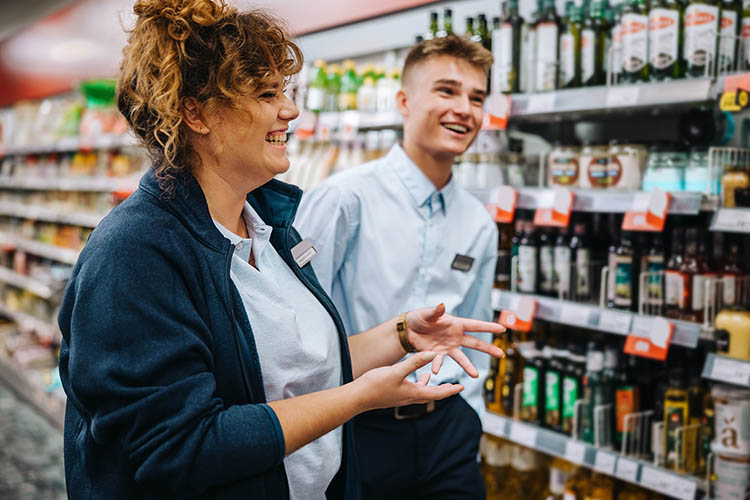
4. Optimising staffing arrangements for customer and employee experiences
Balancing colleague availability with service levels remains a challenge.
By combining real-time footfall data, AI-based forecasting and secure connectivity, workforce management tools can support more responsive scheduling and in-store decision making.
Connected colleagues can access clienteling tools, product information and secure communications on the shop floor, helping them support customers whose journeys move fluidly between app, website and store.
This supports better experiences for shoppers and more manageable, informed working patterns for teams.
5. Meeting sustainability commitments for a better future
Balancing colleague availability with service levels remains a challenge.
By combining real-time footfall data, AI-based forecasting and secure connectivity, workforce management tools can support more responsive scheduling and in-store decision making.
Connected colleagues can access clienteling tools, product information and secure communications on the shop floor, helping them support customers whose journeys move fluidly between app, website and store.
This supports better experiences for shoppers and more manageable, informed working patterns for teams.
Building the foundations for real-time retail
In 2026, technology underpins almost every part of retail operations, from dynamic pricing and retail media to fulfilment and checkout.
For retailers, SASE is no longer optional – it’s the foundation for safeguarding AI agents, in-store IoT devices and payment/identity flows in a unified commerce world.
Leading retailers are building an AI-ready digital backbone, bringing together high-performance fixed and mobile connectivity with secure, software-defined networks.
This foundation supports unified commerce, real-time insight from connected stores and personalised journeys that move smoothly across every channel.
Want to know more?
Visit our retail hub to explore more insights and practical guidance on building this kind of future-ready digital foundation.